

Plan for the future today with London Egg Freeze

Whether you’re exploring egg freezing for the first time or feel ready to begin the process, we understand this can feel like a significant and sometimes overwhelming decision. At London Egg Freeze, our role is simple: to give you clarity, confidence, and world-class care every step of the way.

Schedule an egg freezing consultation with one of our fertility experts to understand your current fertility health and how egg freezing may fit into your long term plans.

Deciding to freeze your eggs is deeply personal. Whether it’s right for you will depend on many factors.

Considerations include your age, ovarian reserve, medical history, lifestyle, and future plans, all of which play a role. Our fertility experts will guide you through the medical, emotional and practical considerations, explain the costs and support you throughout your fertility preservation journey.

Why choose London Egg Freeze as your trusted partner

  • Specialists in fertility preservation

  • Trusted leaders in reproductive medicine

  • Exceptional success rates in egg freezing

  • Transparent pricing

  • Flexible and convenient scheduling

  • Embracing advanced and emerging technology

The egg freezing process

  • Step 01:

    Fertility check & consultation with one of our egg freezing experts

    Your journey starts with a detailed consultation, including an AMH blood test and pelvic ultrasound to assess ovarian reserve and overall fertility health. Your consultant will talk you through your personalised options so you feel fully informed before moving forward.

  • Step 02:

    Stimulation and monitoring

    Once you are ready, you begin stimulation injections to produce multiple eggs in a single cycle, increasing your chances of retrieving healthy eggs. You’ll meet our team regularly, and we will perform pelvic scans to assess follicular development and determine when the eggs should be collected.

  • Step 03:

    Egg collection

    Once the follicles have reached the correct size, a trigger injection to ensure egg maturation is given approximately 36 hours before the scheduled egg retrieval. This is a short, carefully controlled procedure performed under sedation. Using ultrasound guidance, eggs are collected gently and safely.

  • Step 04:

    Assessment of eggs

    Your retrieved eggs will be evaluated and cryopreserved by an embryologist the same day. If you choose to create and freeze embryos, the embryology team will update you on Day 5.

  • Step 05:

    Freezing and storing your eggs

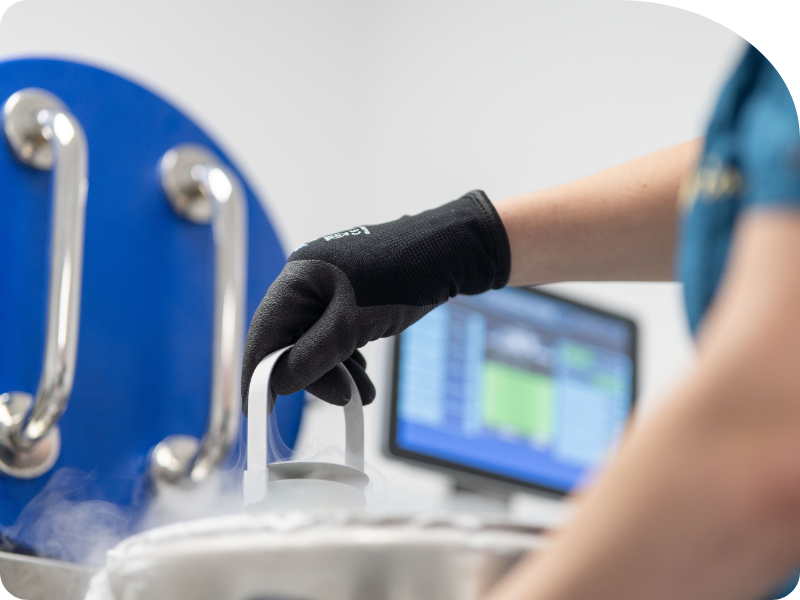
    Your eggs or embryos are preserved using vitrification, a fast freeze technique designed to protect their structure. They are stored securely in liquid nitrogen for up to 55 years, with consent renewed every 10 years.

Fertility preservation pricing

Deciding to preserve your fertility requires careful consideration, and we know the cost of treatment can be a factor when deciding whether to freeze eggs or embryos.

Our treatments are designed to be comprehensive and clear, with no hidden costs. Before starting treatment with us, you will receive a personalised treatment plan, and our team is always on hand to discuss it in depth with you.

Your frequently asked questions

There is no exact number that guarantees a future pregnancy, as every woman’s fertility is different. As egg quality declines with age, current thinking suggests:

  • Under 35: aim for around 20 mature eggs
  • 35 and over: 20–30 eggs may be recommended

Some women may require multiple cycles to reach these numbers. Your consultant will advise you based on your ovarian reserve and response to stimulation.

Egg freezing has no impact on your ability to get pregnant naturally. It preserves eggs you would lose during a normal menstrual cycle, so it does not affect your remaining eggs. It also does not affect your ability to ovulate

The effects of the medications used during an egg freezing cycle are temporary and usually resolve shortly after the treatment cycle is completed, and do not permanently affect your ability to ovulate normally in the long term.

Some parts of the egg-freezing process can feel uncomfortable depending on your personal sensitivity, but most women do not find it painful.

The hormone injections may sting slightly, though our fertility nurses will guide you on the most comfortable way to administer them. During this phase, it’s common to feel bloated or crampy, and the intensity varies from person to person.

The egg retrieval procedure is done under sedation, so you won’t feel anything at the time. Afterwards, you may notice mild abdominal discomfort and some soreness, which usually settles within a few days.

Once frozen, eggs may be stored for up to 55 years from the date they are first placed in storage. However, we will contact you to renew your consent every 10 years. It is important that you keep your contact details up to date with us.

Eggs cannot be tested for genetic health before freezing because they are single cells; any testing would damage or destroy them.

However, once an egg is fertilised and becomes an embryo, it can undergo genetic testing to look for chromosomal abnormalities in embryos created from frozen eggs. The process involves fertilising the eggs, growing the embryos, taking a small cell biopsy from the blastocyst stage, and then freezing the embryo again while genetic analysis is performed.

While it’s not possible to screen eggs themselves, you can improve your chances by freezing more of them to increase the likelihood of developing genetically healthy embryos later on.

There is no legal maximum age limit on using frozen eggs in IVF. Success depends more on the age at which the eggs were frozen, not your age at transfer so, as with donor eggs, older women can use eggs that were frozen at a younger age. We will carefully assess your health before embarking on treatment.

Eggs that have been frozen and thawed are typically fertilised using a fertility treatment called ICSI (Intracytoplasmic Sperm Injection), which is a specialised form of IVF where a single sperm is directly injected into an egg to achieve fertilisation. The freezing process makes the outer coating around the eggs tougher, and sperm may be unable to penetrate it under standard IVF, which involves mixing eggs with many sperm in a dish and letting fertilisation occur naturally.

If you choose not to use your frozen eggs, you have several options:

Donate them to someone else: you may be eligible to donate your eggs to someone else who very much wants a family.

Donate them for training: you can donate your eggs for training purposes, allowing embryologists to practice techniques like thawing and handling. The eggs are then allowed to perish.

Donate them to research: you can donate your eggs to fertility scientists who are doing important work in understanding infertility as well as developing new treatments.

Dispose of them: if you prefer to just dispose of your eggs, they are simply removed from storage and allowed to perish naturally

We will contact you to renew your consent to storage every 10 years, or you can get in touch with us at any point to discuss what you would like to do with your frozen eggs.

Meet our team

Our team of consultants, embryologists and fertility nurses is committed to delivering exceptional care in egg freezing. Explore each team member’s expertise and background.

Dr Xavier Viñals Gonzalez

Embryologist

Maartje Winter

Fertility Nurse

Dr Anna Carby

Egg Freezing Expert

Dr Xulin Foo

Egg Freezing Expert
Kim Hill Embryologist

Kim Hill

Embryologist

Miss Amanda Tozer

Egg Freezing Expert

Quick links

EGG FREEZING SELF TEST Right-bold Right-bold
EGG FREEZING PRICING Right-bold Right-bold
FERTILITY PRESERVATION Right-bold Right-bold
PART OF ARIA FERTILITY

Contact us

8 WELBECK WAY LONDON W1G 9YL Right-bold Right-bold
+44 (0) 203 263 6025 Right-bold Right-bold
ADMIN@ARIAFERTILITY.CO.UK Right-bold Right-bold
PRIVACY POLICY COOKIE POLICY PATIENT BEHAVIOURAL POLICY